


Batch chain optimization: how to reduce the critical window and improve 24/7 availability
As transaction volumes grow and usage habits change - becoming increasingly digital, distributed and real-time - the batch chain becomes a critical point within the operation of financial entities.
The challenge is no longer just making processes work, but how much time they take, what impact they have on availability, and what capacity exists to anticipate deviations.
In this context, optimizing the batch chain ceases to be a one-off technical improvement and becomes an operational and business decision.
It is also a key piece within any strategy of core modernization, where efficiency, control and availability coexist.
In this article we analyze why batch chain optimization became a strategic decision for financial institutions, and what impact the critical window has on availability and customer experience.
In addition, we identify the signs that indicate deterioration in the system and explain which approaches —technical, structural and operational— allow us to reduce times, improve efficiency and sustain a truly 7x24 operation.
What is the batch window and why does it impact the business?
It is important to define three essential elements for the normal operation of a financial entity.
A batch process It is a set of critical tasks for the daily operation of a financial entity, which must be completed so that the next day each of its branches and its virtual means - such as mobile applications or the website - function correctly, on time and in the proper manner.
Meanwhile, the batch chain It is a sequence of tasks or processes that are executed in batches, one after the other, as part of an automated process.
These micro-processes are usually designed to perform repetitive or intensive operations on resources that do not require real-time interaction.
The batch chain can include activities such as data collection, processing, report generation, and results distribution. Its efficient management is crucial for optimizing system performance and ensuring efficiency in processing large volumes of data.
In a financial system, the batch chain may include processing current accounts, and within those current accounts, payroll accounts, processing daily transactions, generating account statements, calculating interest, and updating records.
For its part, the batch window or critical batch window, refers to the period of time during which processes are executed in batches, usually outside of a branch's normal operating hours.
This is the moment when the necessary and essential processes for the operation run, taking into account that in every batch process there are essential parts and others that are not critical.
As he points out Maximiliano Casalaspro, Data Center Services Manager IT Patagonia, it is important to note that batch processes do not require real-time interaction and can be executed in a deferred manner, since they are not decisive for the immediate operations of the branch.
Some examples of these are the generation of current account reports and the maintenance of savings accounts, which do not need to be done during customer service hours.
Common practice is to schedule them to run at night, when the workload on the system is lower and there are fewer users interacting. This minimizes the impact on system performance during daylight hours, when higher user traffic and real-time transactions are expected.
This separation between real-time and batch processes allows for optimised resource utilisation and ensures efficient, uninterrupted system operation during customer service hours.
Furthermore, by running batch processes within a specific time window, schedules and priorities can be set to ensure that critical tasks are completed within specific deadlines and to avoid conflicts with other system operations.
Business Impact
The critical point is that while the batch window is running, service availability is reduced. This directly impacts several aspects:
- Customer experience.
- The ability to complete transactions.
- Operational risk and risk in service perception.
But, beyond the immediate impact, there is a structural effect: A large batch window limits the ability to scale the digital business.
The greater the reliance on these processes, the less flexibility there is to operate in real time. Therefore, reducing the batch window is not just a technical improvement: it's a decision that impacts 24/7 availability, competitiveness, and operational efficiency.
The Optimization Challenge: Why Do It?
Optimizing the batch process is crucial to maximizing operational efficiency.
This results in reduced processing time, minimizing resource usage, and improving system scalability.
And it leads to increased productivity, lower operating costs and a better experience for end users by ensuring fast, reliable and high-quality processing of large volumes of data or batch tasks.
For financial organizations, it is essential to operate in a timely manner. Based on this objective, The duration of the batch process should be as short as possible., since in general, while it is running, many operations do not work and service availability is reduced.
A clear example of the latter is when a person logs into home banking and wants to make a credit card payment at two in the morning. It may happen that the system indicates that the transaction cannot be made at that time.
In certain cases, some banks allow the transaction to be scheduled to take place after six in the morning. But sometimes it happens that the person cannot complete the operation at the time he or she needs to.
This situation, which often generates frustration and compromises user satisfaction, occurs because during that period, the batch process is in progress and no operation can be performed.
So, what we are looking for is to reduce that batch window so that the operation is as short as possible, and so that the user can operate normally.
The importance of being able to do so lies in the need to adapt to people's new habitsUnlike in previous years, today we are constantly using our cell phones to make transfers, check our bank accounts, or make purchases with a credit or debit card, even at night.
Behaviors like these undoubtedly significantly increased the interaction time with entities, as well as placing much greater demands on the batch process.

How to optimize a batch process?
Optimizing the batch process involves a series of key steps, aimed at improving the efficiency and overall performance of the system.
The important thing to keep in mind is that batch process optimization is not a one-time event, but rather an ongoing effort that requires monitoring, iterative adjustments, and constant adaptation as system requirements and operating conditions evolve.
First, it requires a comprehensive evaluation of existing workflow, to identify bottlenecks, inefficiencies, and areas for potential improvement.
This may involve analyzing software architecture, designing algorithms, and optimizing database queries to reduce execution time.
Once the areas for improvement have been identified, they can be apply optimization techniques, such as task parallelization, parameter tuning, query optimization, and efficient use of memory and available hardware resources.
Furthermore, the implementation of continuous monitoring and analysis tools is crucial for Monitor the performance of the batch process and make adjustments as needed to ensure optimal performance over time.
Furthermore, process optimization can also benefit from automation and task scheduling to minimize manual intervention and reduce the risk of human error.
Implementing automated workflows and scheduling recurring tasks can help streamline the process and ensure consistent, reliable execution.
In addition, thorough testing is critical to validate the changes made during the optimization process, and to ensure that no new problems or performance degradations are introduced.

Warning signs: cancellations, diversions, increased travel times
Signs of deterioration in a batch line don't just indicate a technical problem: they are a symptom of misalignment between the current operation and the conditions for which that chain was designed.
In many cases, batch processes were built for data volumes, business logic, and operating windows that no longer exist.
The growth of digital usage, the increased frequency of transactions, and the expansion of channels are rendering these structures obsolete. Therefore, when signals such as increased processing times or deviations appear, What is actually happening is a loss of structural efficiency.
Cancellations, on the other hand, should not be analyzed as isolated events. Their recurrence usually indicates data quality problems, resource saturation, poorly resolved dependencies, and errors in program logic.
Besides, Each cancellation introduces a cascading effect.: re-executions, delays in dependent processes and greater pressure on the critical window.
One particularly critical point is the silent growth of downtime. Unlike a failure, which is visible, progressive growth often goes unnoticed until it becomes an operational problem.
Therefore, a mature batch chain is not one that has no incidents, but one that detects deviations before they become incidents.
In this sense, the difference between operating and managing the batch chain lies in the ability to read these signals as indicators of system evolution, not as isolated anomalies.

How to optimize batch processes: technical and operational steps
Batch chain optimization is not just a technical exercise in performance improvement. It is, in essence, a operational reengineering process about a system that grew in layers over time.
Many current batch chains are the result of years or decades of process accumulation, occasional adjustments, and new functionalities incorporated without structural redesign. This creates redundancies, inefficiencies, and unnecessary dependencies..
That's why, The first real step in optimization is not technical, but conceptual.: understanding which processes should exist today and which ones respond to a logic that no longer applies.
From there, effective optimization combines three dimensions:
1. Technical optimization. It includes program tuning, data access improvements, parallelization, and efficient resource usage. It's the most visible layer, but not necessarily the one with the greatest impact if addressed in isolation.
2. Structural optimization. It involves redesigning the chain: eliminating unnecessary processes, reorganizing dependencies, redefining sequences, and moving processes out of the critical window when possible.
3. Operational optimization. It focuses on how the batch process is executed and managed: automation, reduction of manual intervention, improvement in task scheduling, and standardization of processes.
A common mistake is to address only the technical layer. This may generate marginal improvements, but it doesn't change the underlying dynamics.
In contrast, when optimization is approached holistically, not only are times reduced, but greater predictability, lower operational risk, better use of resources, and the ability to scale without degradation are achieved.
Ultimately, optimizing the batch chain means organizing, simplifying, and aligning the operation with the current reality of the business.
What to measure: Batch KPIs (duration, deviations, criticality, availability)
Defining batch KPIs is not a reporting exercise, but a management decision. What gets measured defines what gets prioritized, and what isn't measured becomes invisible.
One of the main problems in many organizations is that the indicators exist, but they are not aligned with the actual impact. For example, measuring total duration without understanding which processes comprise it limits the capacity for action.
KPIs must meet three conditions:
1. To be actionable. It's not enough to know that the window lasts 5 hours. It's necessary to understand what's affecting it and what can be done about it.
2. To be connected to each other. Duration, deviations, criticality, and availability are not independent metrics. They must be analyzed together to understand system behavior.
3. Translate into business impact. The goal is not to improve technical indicators, but to improve availability, customer experience, and operational efficiency.
A key aspect is incorporating a prioritization logic based on criticality. Not all processes should receive the same level of attention, and measuring criticality allows resources to be focused where the impact is greatest.
Furthermore, KPIs must evolve towards predictive logic. They should not only measure what happened, but also anticipate what might happen. This involves working with trends, projections, and behavioral patterns.
At this point, the leap in value lies in moving from a descriptive measurement to a decision-oriented measurement.
Checklist for prioritizing improvements Before optimizing, it's necessary to organize. The complexity of a batch chain makes intervention without a clear plan impractical.
This checklist allows you to structure the analysis:
- Top 10 jobs by time and weekly trend. It allows you to identify the main time consumers and detect sustained growth.
- Jobs within the critical window identified. Focus on the processes that truly impact availability.
- Dependencies and complete documented chain. It provides visibility into how the supply chain flows and where blockages exist.
- Cancellation frequency per job (and causes). It allows us to detect structural problems and not just symptoms.
- Possible parallelization and rescheduling defined. It opens up opportunities for direct time reduction.
- Defined offloading/optimization candidates. It allows reducing the load on the core and improving overall efficiency.
This approach avoids isolated improvements and allows for building a roadmap with real impact.
Benefits associated with batch process optimization
In addition to reducing execution times, optimization offers other advantages.
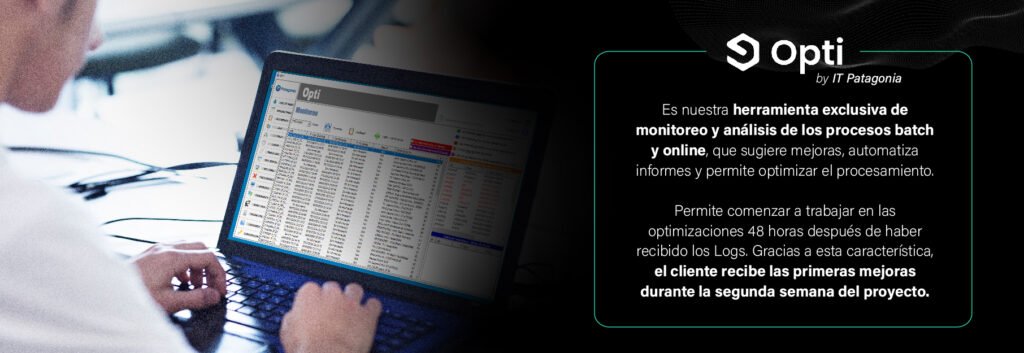
One of these is to speed up the detection of batch processes. A benefit that provides our exclusive OPTI tool, which has 15 years of experience in the market and is installed in all our clients.
To understand its value proposition, imagine that large banks run between 50,000 and 100,000 processes daily. Given this volume, it would be very difficult for teams to identify which processes to optimize without a solution like ours.
OPTI ensures that the process that is optimized, eliminated or debugged is the one that really has an impact on chain times.. It automates report generation, analysis and monitoring, and facilitates batch controls.
The tool takes a “snapshot” of the batch process and, in approximately two to three weeks, allows you to know where you need to optimize and reduce times.
Then, a specialized team works on the different platforms, which is responsible for optimizing these programs or cleaning and refining the chains, so that the times are reduced.
Although there is a scheduler that runs the batch chain processes, it is needed qualified people to operate it and ensure that the processes are completed in a timely manner.
How to sustain improvement: monitoring and prevention
Batch chain improvements cannot be sustained by inertia. In dynamic environments, where volumes, business logic, and technology change, any optimization tends to degrade if it is not actively managed.
That's why, The challenge is not just to optimize, but to institutionalize continuous improvement..
Monitoring ceases to be a control tool and becomes a management system. It's not just about seeing what happened, but about building a capacity for anticipation.
In this sense, prevention is based on three pillars:
1. Continuous visibility. Knowing at all times what is happening in the batch chain, which processes are at risk, and how the execution is evolving.
2. Operational intelligence. Not only detecting deviations, but interpreting them. Understanding what is relevant, what is noise, and what requires intervention.
3. Responsiveness. Having defined processes, roles, and actions to intervene quickly without affecting operations.
A critical point is to prevent monitoring from becoming isolated within the technical area. To sustain improvement, it must be integrated with operational management and, in many cases, with business-level decision-making.
Furthermore, prevention allows us to shift the paradigm: from reacting to incidents to preventing them from happening. This approach not only reduces risks but also frees up the team's capacity to focus on higher-value improvements.
In short, a mature batch chain is not one that was optimized once, but one that has the ability to adapt continuously without losing control or predictability.
Optimizing the batch chain is a decision that directly impacts availability, costs, and experience.
Request a specialized diagnostic meeting with our team: Click here
To learn more about mainframes: Click here


